
荷兰中西文化文学国际交流研讨会文集发行
本网讯
由荷兰作家池莲子主编,黄卓越教授撰序的《东芭西篱第一枝:2012首届荷兰中西文化文学国际交流研讨会论文集》近日由华夏出版社正式推出。此次会议于2012年4月在荷兰代尔夫特市举行,由荷兰彩虹中西文化交流中心发起,全荷华人社团联合会、世界华文作家交流协会等联办。
该集选编了来自于加拿大、日本、澳大利亚、韩国、新加坡、新西兰、西班牙、美国、荷兰、德国及中国香港与内地等华文作家、学者、批评家的多篇论文,分为“中西文化双向传播中的文学交流”、“中西文化交流与区域文学研究”、“文化诗学建构与文学交流空间的开辟”三大专题,近40万字,展示了各国学者、作家对中西文化交流、世界华人文学研究的最新心得。
【附】黄卓越教授所撰序言
Preface
A long time ago I read a poem on Holland, and the line that impressed me most was “Holland, that low,low, low land”, a line creating a gloomy but lingering tone which repeatedly echoed in me and haunted me, thus connecting my heart withHolland. Fate finally brought me toHollandat the end of this April, because of Ms. Chi Lianzi’s invitation for the conference on culture and literature held inNetherlands; and this autumn, again because of her invitation, I got the opportunity to write a preface for the book growing out of the conference, which gave me double pleasure.
The conference, at the call of Ms. Chi Lianzi, is entitled as “the International conference on Chinese-Western Culture and Literature ”. With a clear focus as well as broad inclusion , the participants are not just from Netherland or Europe, but also from North America, South-East Asia,Australia,Japan,South KoreaandChina, engaged in different professions such as writers, scholars, critics, journalists and the others. All these constituted the characteristic of the conference,that is, people from all over the world meeting and discussing the exchange in Chinese-Western culture and literature in depth. This conference differs from the ones I have attended before in that it is difficult to pin down a clear thematic range of the issues, as it is more a display of diversity. But this brings special advantages that in the broad scope of Chinese-Western exchange we can hear many different voices, and obtain more unfamiliar and fresh knowledge. I’ve also had the luck to read the submitted papers afterwards. Varied in perspective and length, these papers state their own view with the understanding of their own, doing result in a stimulating shake up of flows of thought.
Historically, the contact and exchange betweenChinaand the Western /other countries dated back to Tang Dynasty, or even earlier to Han Dynasty, during which, merchandise, information and silver were the main concerns of exchange while trades, religion and war could be the main impetus of the contact. The discoveries made by Columbus' and Da Gama's voyages are generally thought of as the start of forming new world system at the end of 15th century. But the Western countries are dominant in constructing this new system that carried the ever-increasing modernity and pre-colonial impulse.China, unavoidably and passively involved into the huge trans-territorial mobility, became one of the participants in constructing the new order. The entry of missionaries represented by Matteo Ricci intoChina can be seen as the beginning of the new round cultural exchange betweenChinaand the West in the 16th century. With a sort of 'sense of superiority' for their cultural mission, they came toChinaas the first batch of immigrants emigrated fromEurope, including some Hollanders speaking Flemish Language (according to Jean-Pierre Duteuil, 18 people). Since then, Chinese-Western exchange accelerated unbalancedly and promoted the transformation ofChina's society. The wave of large-scaled emigration abroad sprung up till about the middle of 19th century, accompanied by the Western urgent need for market expansion and the intense reverberation in domestic politics, economy and thought inChina.
While probing into the relationship and exchange between China and the West, we always focus on economic and technical communication as well as the dissemination of ideas and knowledge, and mainly looked into the impact on Chinese society and thought. Such perspective is inevitable and it would be unnecessary to doubt it. The emigrants, however, are quite different from the communication of the information and objects ,in that an ethnic group comes to a foreign territory and are embedded in another nation , which, in comparison with the previous goods and information exchange, is a more special and direct way of trans-territorial exchange, creating remarkable significance both to the nation of emigrant and the nation of the immigrant. Emigrants can be seen as a special medium of cultural exchange between two nations. Of course, the West-dominance/China- passivity pattern has led to unbalanced and unfair immigration, which has resulted in early Chinese immigrants only as physical laborers and as the marginal culturally and politically. There is no exception in the immigrants in the South-East Asia,AmericaorEurope. Just to use theNetherlands,SpainandItalyas examples, by the 1980s, about 90 percent of the first two generations who had emigrated from the rural areas of the South of China made a living as laborers. Such an early structure of immigration manifests to the great extent the repercussion of the constant effect of the Western premodern capital accumulation, though the cultural representation and creation have always existed in the Chinese immigrants' world of life in a faint way.
The emergence of new emigrants has changed the inner structure of emigration. No matter when the new emigrants emerged, in the1980s or 1990s, they were closely related to the new round of globalization. These new emigrants are from more diverse places, even though the traditional work emigrants still form a big group, more and more technical emigrants, exchange students and commercial emigrants find their way in(marriage emigration being on the rise). Many emigrants of this new group have enjoyed a high education inChina, produced a great influence on the the transformation and reorganization of immigrant groups. This change has first shown itself in the conscientiously raising the subject consciousness embodied in organizing various overseas Chinese community and founding overseas Chinese media as well, which enjoyed great development in the late 1980s and 1990s. Thus a vast space has been pioneered for consolidating the ethnical feelings and constructing the ethnical identity, Meanwhile, the concept of pluralism has been propelled to spread in the land dominated by the Occidentalism. As far as the cultural dimension is concerned, it is well worth mentioning the new immigrants' writing in Chinese— conveying the consciousness of culture and identity autonomy by symbolic expression and creation —has blossomed.
Writing in Chinese is generally called 'Huawen Literature'(or 'Huayu Literature' )and can be diverse. In this sense, ‘literature’ is not so much seen from a professional perspective adopted by the mainland Chinese, but more conjunctional with the concept of 'culture' just as some critics put, to write with a 'mixed' style is the very means for the overseas Chinese to account their particular feelings and way of knowing. Many academic discussions and names have been given to the writing in Chinese in recent years, but in my opinion, though the analysis might be necessary, there’s no sense in making it more complicated or trivialized. Whatever has been written down, 'Huawen Literature' is the writing based on Chinese language, which is not only the main characteristic of “Huaren literature”, but the premise for us to communicate in the same topic. There can be no doubt that language itself is one of the symbols of ethnical identity while connoting the writer’s education background. Language is not an empty signifier, instead it contains specific cultural connotations. Besides, to write in the mother tongue in a foreign country embodies the certain ethnical belonging because the writing will be impacted by their expectation on the preset readers. Of course, the differences in writing caused by different generations, regions and personal experience within one language community will have an effect on the narrative of a text. Compared with writing from the mainland, the emigrants' writing undoubtedly showed the regional differences which have been fully expounded and proved by many scholars, and invited no words.
'Huawen Literature' (Chinese writing of emigrants), growing from the scattered to the clustered and to the blossomed everywhere, has now formed a marvelous landscape in Chinese writing. However, regionality has been playing a great role in the growth and characterization of Huawen Literature, and thus its developing rhythms and tracks vary from region to region. Since the1980’s, More attention has been paid to the Huawen Literature first from Southeast Asia and North America and then from Austrulia due to the publication of an anthology ofAustralia's Chinese literature at the beginning of this century in token as a group. In contrast, Though European writing in Chinese with some excellent Chinese writers and texts, like the pearls in the field, were left ungenealogized because of the relative late start and no propaganda . It is because of the above-mentioned that this international conference has been held in the Netherlands has a special significance, for it is both a meeting for communicating and exploring the European-Chinese literature with people from all over the world, and a meeting for witnessing the presence of European-Chinese literature. Therefore, a new landmark has been established in the map of the Chinese writing in the world for gaze and for view. I’m so pleased to witness the success of the conference , willing to write this preface for commemoration.
Papers submitted for the conference, of course, are not limited to the Huawen literature, but involving several concepts and issues at different levels, which is determined by the theme of the conference. As the largest framework of the conference, Chinese-Western exchange, being more than the transnational ethnical migration, was presented by many speakers, which shows the inherent multi-routes in Chinese-Western exchange, among which specific treatment will be done from the view of comparison, spreading, impact, to name a few. As said, Huawen Literature, though the second-class issue, became the central subject of this conference. On the one hand, it is encompassed in the framework of exchange betweenChinaand the West. On the other hand, it has formed a new discourse field with a relatively independent dimension. Readers, while reading the book, can also combine the issues at different levels, from a facet to a point or vise versa, whereby to acquire richer perceptions .
The conference is held in the context of ever-expanding globalization. Today's world is different from yesterday's. With the worldwide diaspora of people accelerating and diversified, some new variation modes emerged; along with a variety of communication technologies developed (such as the Internet, E-mail, Twitter and WeChat and electronic video, etc.), the cross-border communication exhibits the trend of space folding and deterritorialization. Hybridity of different cultures become a part of normal life, and the information exchange with the mother country can be completed in an instant, unlike the hard and stagnant one in the past. All these no doubt will significantly alter the form and function of the exchange of cross-domain , and make such concepts pending as 'ideology', 'nationalism' , 'diaspora' and 'double identity' ,etc. Presumably immigrants daily perception and idea also lends a qualitative conversion so as to have a profound effect on writing in Chinese and Huawen literature. In a word, how to combine these phenomena to further explore Chinese-Western exchange and Huawen literature in the new situation will be the direction of one of our joint efforts in the future.
The conference, being short, has been gradually immerged into the landscape of history with the passage of time. How can we remember this precious time? By this book.
Huang Zhuoyue
October, 2012 inHaidian District, Beijing
- 上一篇:文慕贝——如实地记录中国
- 下一篇:苏慧廉的传记《寻找苏慧廉》出版


-
【世界汉学讲坛】《关雎》英译探微:
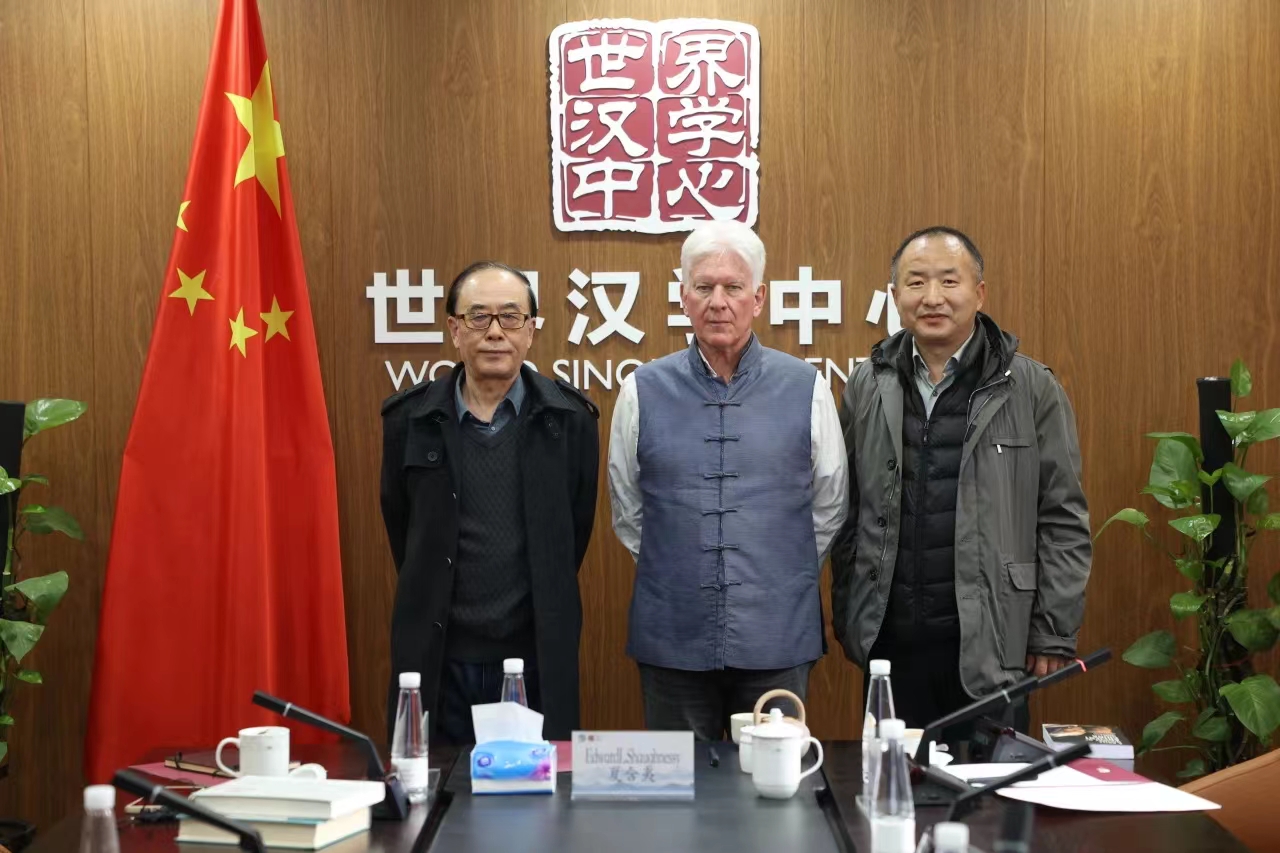
3月11日下午,著名美国汉学家、芝加哥大学教授夏含夷( Edward L. Shaughnessy )主讲2024年
- ·世界汉学讲坛 | 何广思教授解读中拉
- ·阿根廷何广思:超越西方范本才能获
- ·阿尤布:中国在实现现代化的同时,
- ·黄卓越:早期中国的书写与汉学研究
- ·薪火永相传,著名汉学家马克林讲汉
- ·《人民日报》:《用翻译架起中葡文
- ·蔡宗齐(美国):开辟中国文化走向
11 月 22 日下午,由中国国际交流协会、北京语言大学主办、世界汉学中心承办的世界汉学讲坛第九讲成功举办。本次讲坛由...
10 月 18 日晚,中国国家主席习近平在人民大会堂会见来华出席第三届一带一路国际合作高峰论坛的阿根廷总统费尔南德斯...
日前,由北京语言大学世界汉学中心牵头建设的土耳其汉学家理事会在青岛正式成立,土耳其汉学家理事会召集人、土耳其著...
摘要:该文原为作者2021年10月20日在北京语言大学一带一路研究院举办的一带一路汉学研究论坛上所做的现场演讲,对海外汉...
2023年6月7日下午,薪火永相传大师说汉学暨世界汉学讲坛第四讲成功举办。澳大利亚著名汉学家、澳大利亚格里菲斯大学荣誉...
2023年02月01日,《人民日报》(海外版)第7版刊登了《用翻译架起中葡文化交流的桥梁》一文。文章由新汉学计划海外高级中...
天下学问一家: 开辟中国文化走向世界新路径 蔡宗齐 蔡宗齐(Zong-qiCai),美国伊利诺伊州立大学香槟校区东亚语言文化系...